
Wallgarden. From business signals to decisions.
Watches your business systems against your goals, and proposes actions a person approves.
How it works · WLGRN
A finding's journey. From reading to result.
Wallgarden reads your systems against your goals, brings a decision with its evidence, acts only inside the limits you set, and comes back to check whether the claim held.
01 / 08GOALS SET
Start from the goals
Say what you are trying to achieve, why it matters and who owns it. Everything after is ranked against that.
Read the figure as text
- Start from the goals. Say what you are trying to achieve, why it matters and who owns it. Everything after is ranked against that.
- Read the real numbers. Connect a system, or enter figures by hand. Each figure keeps its source; missing data stays missing.
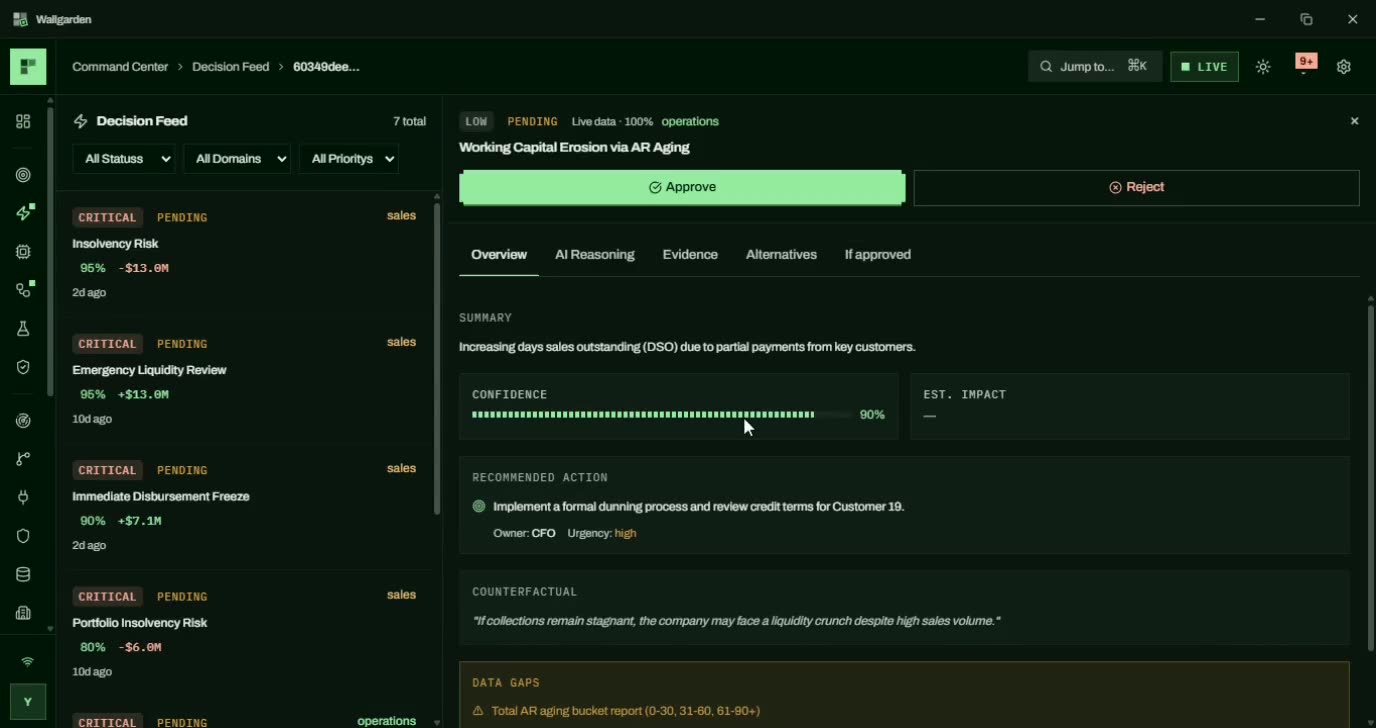
- Bring a brief. A finding becomes a brief: the evidence, a proposed action, an owner and a deadline.
- Check the limits. Versioned limits decide what may happen on its own. Beyond them, a person approves or declines.
- Act, and keep the thread. Within the limits the action goes ahead; a tracked request keeps its owner and due date.
- Measure the claim. Later readings, over the metric's own horizon, decide whether the decision did what it claimed.
- Or say it cannot be measured. With no reading, the claim stays unmeasurable. It is not counted as a success and it does not inflate the record.
- Remember for next time. Decisions and their outcomes go into memory, so the next finding starts from what actually happened.
- Goals and owners: State what you are trying to achieve, why it matters and who owns it. Qualitative goals stay qualitative.
- Connected systems: One real source of numbers is enough to start. Only staffed domains run.
- Findings: Agents read the goals and rank what they find against them, each figure keeping its source.
- Decision brief: A recommendation with its evidence, an owner, an action and a way to check its result.
- Operating limits: Versioned limits define what can happen automatically and what needs approval.
- Approval: Outside the limit, a person decides. The request is tracked until it is completed or declined.
- Action: The action proceeds, with an owner and a due date that stay attached.
- Observe: Later readings, taken over the metric's own time horizon, are stored as they arrive.
- Measured outcome: The verdict comes from an observation, not from the model's account of itself.
- Unmeasurable: A claim with no reading stays unmeasurable. It never counts as a success.
- Memory: Every decision and what came of it is kept, so lessons compound instead of being relearned.
Try it · WLGRN
Autonomy has a limit. A person owns it.
Recommendation. What should be done.
Within limits
What it is
A finding needs an owner and a test.
For owners and executives of mid-sized companies. Connect the systems the business runs and state its goals; Wallgarden brings each finding with the figures behind it and a proposed action, a person approves, and later readings show whether the claim held.
A useful recommendation needs someone to own it, an action and a way to check the result. Wallgarden carries that thread from the first reading through approval and follow-through, without filling missing data with invented figures.
Decisions that keep arriving late?
Say what it should do, which data it can touch and where it has to run. A person replies by email.