
Cordon. Sovereign inference, signed at the source.
Runs your language model on your own hardware, and signs every answer.
How it works · CRDN
A request's journey. Through one door.
Every request passes one check after another inside your boundary, and the answer leaves signed, so anyone can check it offline.
01 / 07MTLS
An enrolled client asks
Mutual TLS identifies the caller from its enrolled client certificate. There is one way in.
Read the figure as text
- An enrolled client asks. Mutual TLS identifies the caller from its enrolled client certificate. There is one way in.
- A stranger is refused. A caller without an enrolled certificate is refused at the gate. It never reaches policy, the record or the model.
- Policy before inference. Model permissions, prompt limits, token budgets and rate limits are checked before the model is asked.
- Logged before processing. The request is written to the record first, so even a request that fails later is accounted for.
- Inference on loopback. The supervised runtime is bound to loopback, unavailable as a second public endpoint.
- Filtered, then signed. Output rules redact, truncate or block, on streaming responses too. Then the canonical response is signed.
- A record anyone can check. The answer leaves with its signature and the entry joins the chain. Both verify offline, without the serving node.
- Enrolled client: A system or person enrolled with a client certificate. Its identity travels with every request.
- Unknown client: Anything that has not been enrolled. It never reaches the model.
- Client identity: Mutual TLS identifies enrolled clients. This is the only way in.
- Refused: No certificate, no request: refused before policy, before the model, before anything is kept.
- Policy & admission: Model permissions, prompt limits, token budgets and rate limits are checked before inference.
- Pre-write audit: The request is written to the record before the model sees it.
- Local runtime: A supervised local runtime generates the answer, on your machine, behind the control plane.
- Output filter: Output rules redact, truncate or block content, on complete and on streaming responses.
- Signature: The canonical response is signed, so a client can verify it offline.
- Hash-chained record: Signed, hash-chained audit entries can be verified without contacting the serving node.
The receipt
Every answer leaves signed. Check it without us.
CORDON_RESPONSE_v1
|{request_id}
|{output_hash}
|{model_id}
|{timestamp_ms}
|{mrenclave}

signature: Ed25519 over the line above
verify:    offline, with the node's public key
Fields as signed by cordon-api. The audit log stores hashes, never prompts.
Deployment modes
Choose the trust boundary. Laptop to air gap.
| Mode | Where | Outbound | Models arrive | Root of trust | Identity |
|---|---|---|---|---|---|
| Light | A laptop or a development server | Allowed | Pulled from Hugging Face | None required | Mutual TLS optional |
| Sovereign Cloud | Your own cloud account | Allowed | Pulled, then sealed | SEV-SNP or TPM 2.0, pinned | Mutual TLS required |
| Vault | A regulated data centre | None | Encrypted bundles, management channel | SEV-SNP or TPM 2.0, pinned | Mutual TLS required |
| Island | A private network, no management channel | None | Physical media | SEV-SNP or TPM 2.0, pinned | Mutual TLS required |
| Dark | An air-gapped rack | None | Physical media | SEV-SNP or TPM 2.0, pinned | Mutual TLS required |
From a laptop
Pull a model, run it behind the door, check the install.
cordon pull HuggingFaceTB/SmolLM2-360M-Instruct-GGUF
cordon run smollm2-360m-instruct-gguf

cordon doctor
Try it · CRDN
Alter one entry. Watch the chain break.
- 01
client=knott model=qwen2.5 admit47145b56 - 02
client=knott output=redacted sign9cd431be - 03
client=matta budget=ok admit83aff940 - 04
client=matta output=complete signd4a258a5 - 05
client=wallgarden rate=ok admit10988048 - 06
client=wallgarden output=truncated sign12e8fbd3
Not yet checked
What it is
The model is only part of the deployment.
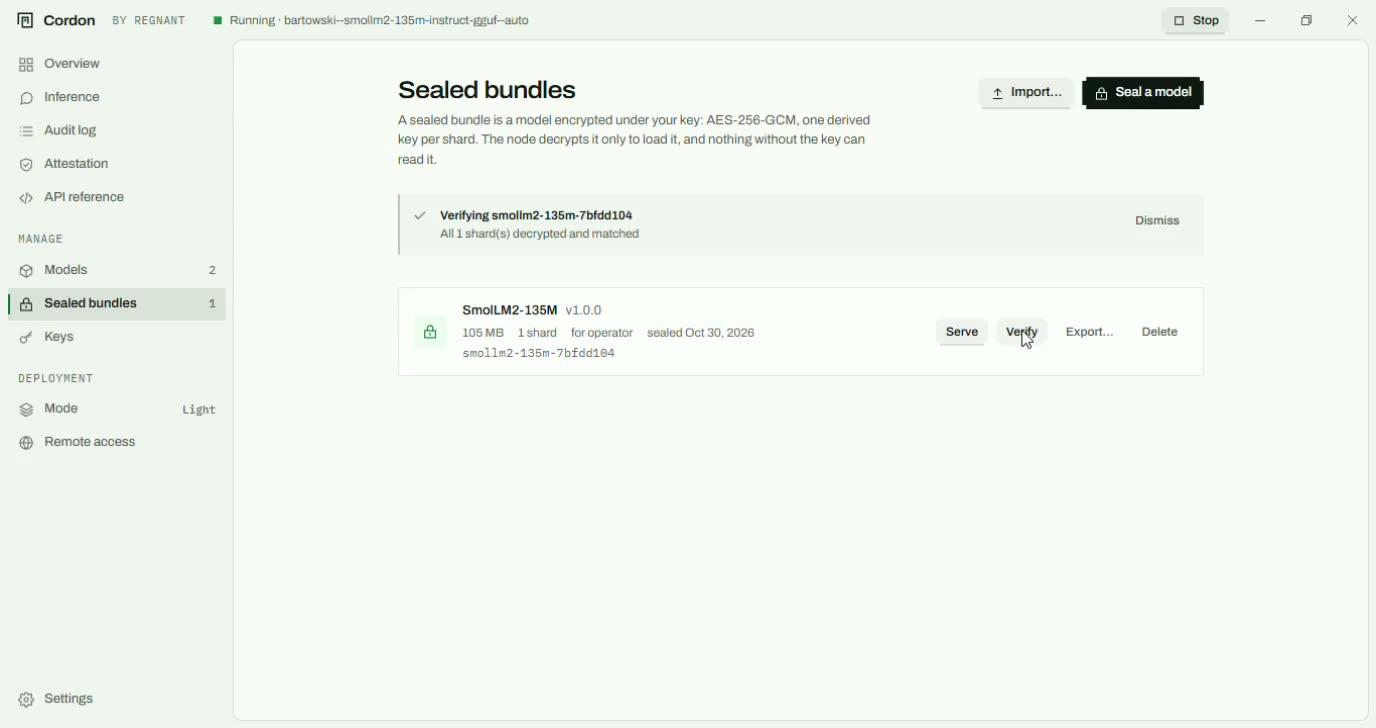
For organisations that have to run AI inside their own network. Cordon sits between your applications and the model: it identifies each caller by certificate, writes the request to a signed log before the model reads it, filters the answer and signs it, so anyone can check it later without trusting the operator.
Who can use it, which data it can release, and how you reconstruct a request matter just as much. Cordon supervises the local model runtime behind a single control plane, with the runtime bound to loopback so it cannot be reached as a second public endpoint.
Sourceregnant-io/cordon
Running a model inside your own network?
Say what it should do, which data it can touch and where it has to run. A person replies by email.